
Map a Baltimore Resident Lookup
No single Baltimore roster turns a name into a full resident profile. Every Baltimore record answers a narrower question instead. Maryland SDAT Real Property Search is a Baltimore assessor record. It does not prove who occupies a Baltimore property. Maryland Judiciary Case Search provides Baltimore public case summaries. Voter Search exists mainly for a Baltimore registrant's own record. Old Baltimore directories and newspapers carry dates, so treat them as historical. Hold these Baltimore distinctions in mind. A same-name lead stays a lead rather than a false identification.
| Record channel | What it can confirm | Baltimore route | Access limit |
|---|---|---|---|
| Baltimore SDAT parcel card | Baltimore parcel, deed reference, owner line, mailing and situs fields | Baltimore SDAT Real Property Search | Public Baltimore assessor index; not occupancy or legal title |
| Baltimore voter registration | A consenting Baltimore voter’s status, polling place, districts, and ballot services | Maryland Voter Search | Baltimore self-lookup requires name, date of birth, ZIP, and validation |
| Baltimore court case summary | Baltimore party role, case number, type, status, filing date, and caption | Maryland Judiciary Case Search | Public Baltimore summary only; protected categories are omitted |
| Baltimore vital index or certificate | Historical Baltimore birth, death, marriage, divorce, or family-event leads | Maryland State Archives guides | Baltimore series restrictions, eligibility, and fees apply |
| Baltimore license or entity record | Baltimore credential status, public business contact, or filing history | Maryland Business Entity Search | A Baltimore resident agent or business address is not a home address |
Start by separating Baltimore City from Baltimore County. Baltimore City is an independent city and counts as its own county-equivalent. SDAT searches Baltimore City under county code 03. You can search by address, street, account, PAN, or map reference. A PAN is simply the Baltimore City ward, section, block, and lot identifier. The portal offers no owner-name or ZIP searching. A known Baltimore name paired with an approximate year usually fits a Baltimore court or directory search better. It also suits an archive or credential search.
Check Baltimore Court Lookup Fields
Maryland Judiciary Case Search keeps Baltimore City Circuit Court and District Court separate. Its Baltimore party search accepts person or company. Fields include last name, first and middle name, party type, case type, court system, county, and exact or ranged filing dates. Last-name matching is exact by default. For a partial surname, the official instructions say to enter the first character. Add a percent sign at the end. Broad Baltimore names can hit the portal's 500-result cap. So add a court, case type, date range, middle name, or party role before reading a no-result or shortened list as meaningful.
Coverage dates double as a useful Baltimore date check. Baltimore City Circuit civil summaries begin November 23, 1998. Criminal summaries begin in 1993. Baltimore District civil coverage starts in 1989. Criminal coverage there begins in late 1991, subject to historical exceptions. Older Baltimore files or fuller detail sit with the clerk. The Maryland Judiciary Baltimore City directory names the correct Baltimore court office and division.
Note: A no-match can reflect a date cutoff, a shielded record, exact-name syntax, too many results, or the wrong court filter.
Read Baltimore Lookup Results Carefully
Treat a Baltimore public case result as a summary. Do not convert it into a biography. The Baltimore results table can show case number, party name, date of birth, party type, court, case type, case status, filing date, and case caption. Case Search also offers CSV, Excel, or XML export. Save the Baltimore search date and source URL, and use only the least date-of-birth detail needed to separate people who share a name.
- Baltimore case number: the identifier needed to ask a Baltimore clerk about the correct file.
- Baltimore party role: the listed connection to a case, not a conclusion about a person’s current status.
- Baltimore court and case type: the fields that separate Circuit and District results and help narrow same-name matches.
- Baltimore filing date and status: dated summary fields that may change and do not replace the court file.
- Caption: the Baltimore case title, which should be read with the party role rather than alone.
- Docket
- The court’s running record of filings and events in a case. A public search result may not contain every docket entry or filed document.
- Index and image
- An index identifies a record and its fields; an image is a view of the original document or scanned page. Access can differ between them.
- Certified copy
- A copy issued or authenticated by the custodian for an official purpose. Ask the clerk or records office about eligibility and current charges.
Verify a Baltimore Resident Across Records
Match a Baltimore identity in layers. An exact name is only a lead. A stronger historical Baltimore match combines independent details, such as name with an exact address-year, or name, spouse, and a dated trade. Reserve any current Baltimore identity for consent-based or official self-service confirmation. SDAT, permits, business filings, and a Baltimore city-directory line can each point to an address or relationship. None of them alone proves a present resident.
- Write down the full name, name variants, approximate year, and one independently known Baltimore detail such as an old street or record number.
- Use SDAT by address or PAN when a Baltimore City parcel is known, and label the parcel location separately from its mailing field.
- Run a narrowed Baltimore Case Search party query, recording the court, party role, case number, filing date, and only the minimum disambiguating fields.
- Check a dated Baltimore directory, newspaper, cemetery, or archival index for an independent address, family, or time-period match.
- Request an eligible vital, probate, or clerk record only when the date and identity evidence support that next step.
The evidence ladder is simple. One same-name result is a lead. Two independent identifiers can support a probable historical identity. Three or more matching sources, including a primary or near-primary source, make a stronger historical match. Keep conflicting dates or addresses in the notes rather than forcing a fit.
Respect Baltimore Voter Lookup Limits
Maryland Voter Search is an authenticated self-service check, not a public name-only Baltimore resident lookup. The current form asks for first and last name, date of birth, a five-digit Maryland residential ZIP, and usually street-number or address validation; a middle initial is optional. A successful self-check can display registration status, polling place, districts, local board, ballot services, and sample-ballot information. It does not create a public street roster. The official voter-search screen shows the requested self-service fields.
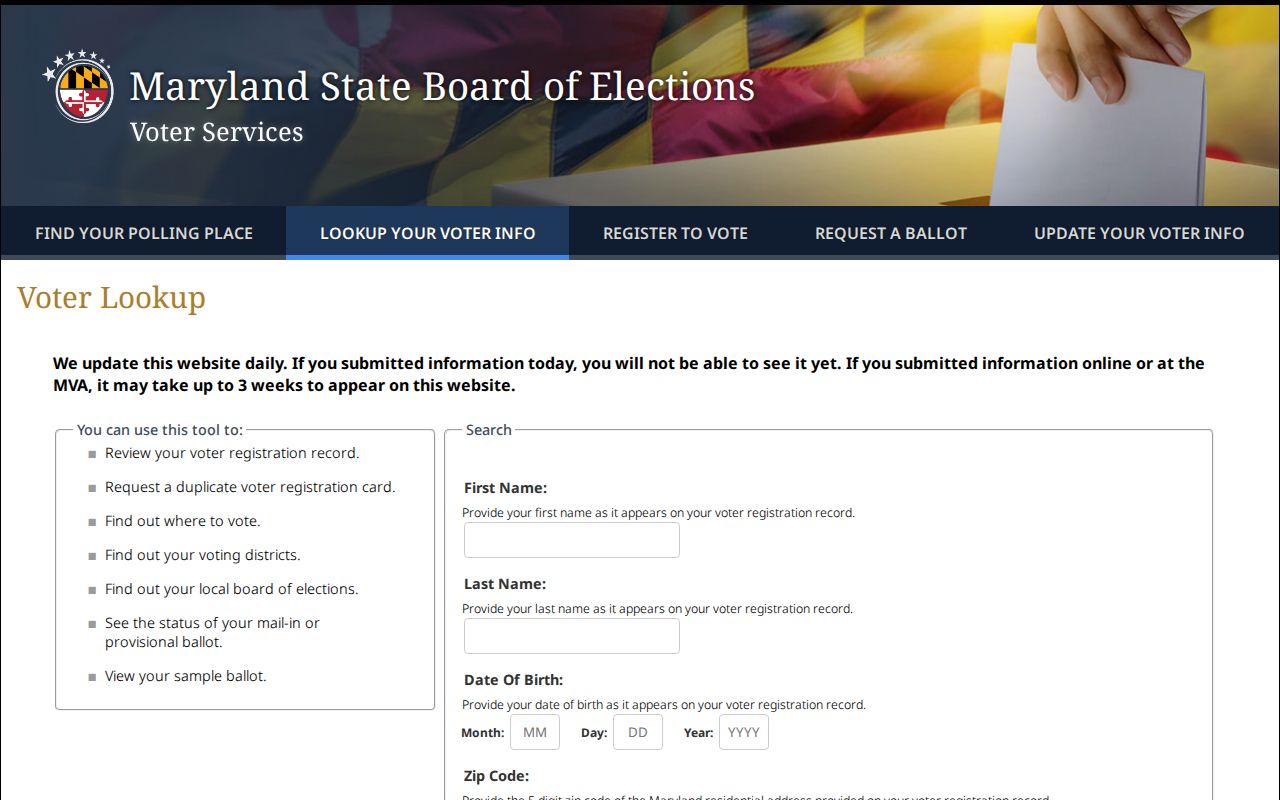
Use the service for the voter's own record or with consent. A no-match may simply reflect spelling, a former name, a wrong ZIP, or an update lag. So treat it as a puzzle rather than proof of nonregistration. Qualified requesters may seek voter lists for electoral-process purposes through the State Board or local boards. The form specifies jurisdiction, list type, active status, date range, party, delivery, payment, and an oath. That form bars commercial solicitation, sale, and unrelated investigation. The Baltimore City Board of Elections is the proper local contact for registration and ballot questions. It is not an informal people-search desk.
Use Baltimore Vital Record Routes
Start a vital-record search with one event and one date. That focus saves hours. Baltimore City birth records begin in 1875. The Archives guide describes an index through 1941 and records through 1972. Deaths run differently. City material spans 1875 through 1972, Archives or state series cover 1973 through 2014, and current service sits with the Maryland Department of Health. Marriage, probate, cemetery, obituary, and newspaper leads often fill in a missing date or name form before any certificate request is made.
The historical birth index has a quirk. Entries arrange by the first letter and first vowel of the parents' surname. Use it when a plain alphabetical search stalls. The index can yield parent names, a date, and a certificate number, but it is not itself a certified record. Current certificates carry eligibility rules, identity requirements, and fees. Baltimore City's local health department does not issue them. The Maryland Department of Health Division of Vital Records and the Maryland State Archives provide the applicable routes.
Adoption is a separate path. Maryland's Adoption Search, Contact, and Reunion Services serves eligible adoptees, birth parents, and birth siblings through a mutual-consent registry and trained Confidential Intermediaries who preserve statutory confidentiality. Never infer a protected birth parent from a directory match or a same-name result.
Request Baltimore Records Under MPIA
An exhausted online index is not a dead end. Identify the custodian before writing anything. Maryland's Public Information Act (MPIA) presumes access but recognizes exemptions, and it has no central request office. Name the record precisely in your request. A date range, address, parcel, case number, or other narrow identifier helps the custodian act. State whether an electronic copy, an index, a log, or a redacted version would meet the need. Custodians must respond within 30 days. Searches expected to exceed ten working days require an estimate and a reason to the requester.
Local routes show how this works. The Baltimore Police MPIA request route accepts 911 audio, body-camera material, CCTV, CAD, photographs, and closed-case files, subject to redaction and access rules.
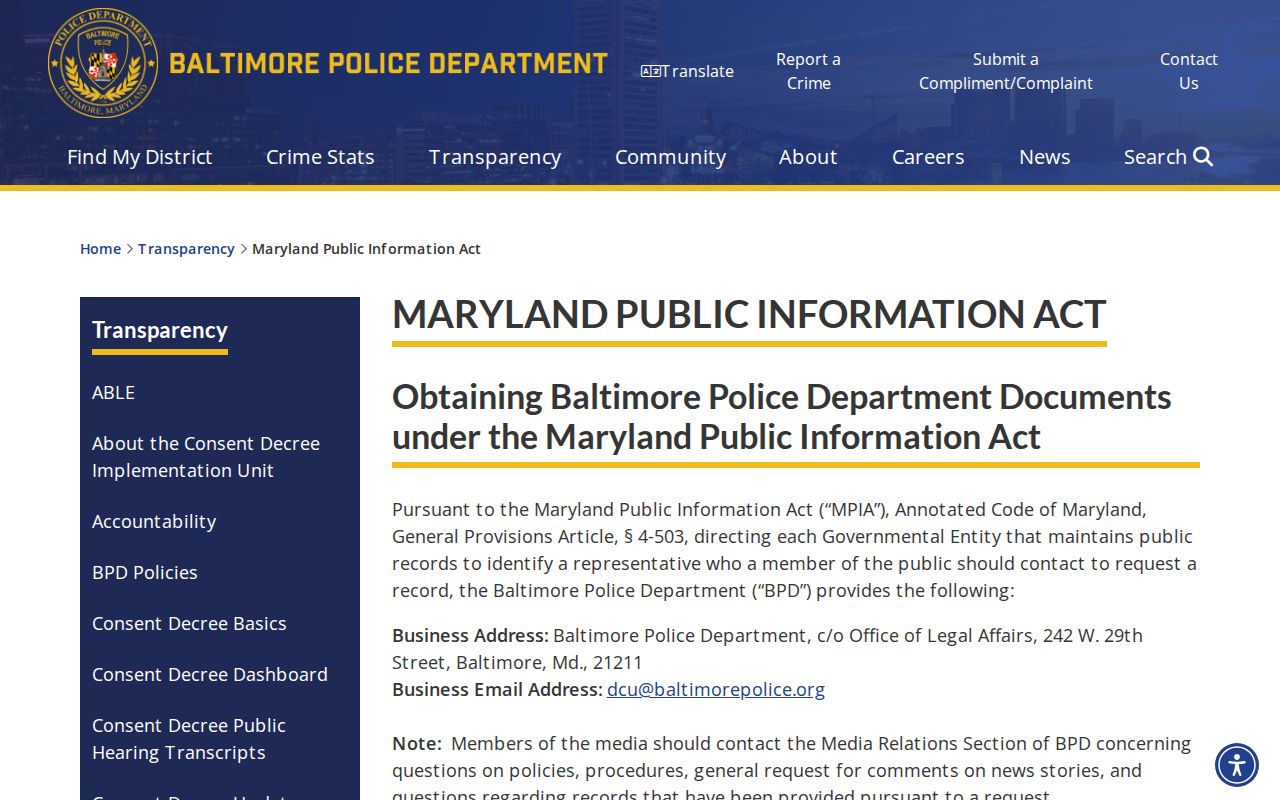
The first two hours of PIA search time are free. After that, reasonable fees may apply, and protected details may still be withheld.
Limit a Baltimore Resident Lookup
The Maryland Public Information Act has limits. It does not override vital-record restrictions or court confidentiality. Juvenile matters, medical privacy, voter protections, and protected addresses keep their own statutes. Some shields are absolute. The Secretary of State's Address Confidentiality Program gives qualifying survivors and threatened people a substitute address with mail forwarding. Statutes and court orders can protect actual addresses too. Never tell an applicant to update public systems before enrollment. An omitted address is a protection, not an error to be exposed.
Maryland's Online Data Privacy Act grants rights over covered data practices. It is no universal eraser for public records. Corrections belong with the creating custodian. Try SDAT for a parcel card, the elections board for registration, the clerk for a court file, and the vital-records agency or Archives for a certificate or index. Paid profile services often carry stale addresses, merged same-name records, and missing protected data, and an opt-out from one service never erases the original government or archival source.
Lawful use. Use Baltimore records for personal, lawful research, family history, estate questions, civic transparency, or an authorized request. Do not use information from a resident lookup to stalk, harass, intimidate, or harm anyone.