
Map Baltimore Previous Residents by Era
The right path to Baltimore previous residents depends on the era you need. Start recent. The current Baltimore SDAT card hands you a parcel key and a recorded-deed reference. From there, the Baltimore City Archives address and block path covers 1972 to the present. It also points toward older series. Those older layers run deep. Historical block, grantor, and grantee records reach much further back in time. Dated Baltimore directories, maps, census schedules, permits, and death or probate sources each add a household name. Some fix a firm endpoint instead. Treat every source as an answer to its own question. Do not expect one continuous list of past residents.
| Baltimore source | Years or date behavior | Where held | What it can show |
|---|---|---|---|
| SDAT parcel or tax card | Current assessment card; no single public historical cutoff stated | Maryland SDAT and city tax route | PAN, owner line, mailing and situs fields, use, values, and deed reference. |
| Address and block land search | 1972 to present stated by the BCA guide | MDLandRec and courthouse | Block or street results and the oldest reference for the deed chain. |
| Historical indexes | Core block and party indexes from 1851 into later specialized series through 2002 | MSA, MDLandRec, and courthouse | Prior parties, block books, book/page, and unlocated references. |
| City directories | 1752 to 1901 MSA collection; listed repository holdings through 1964 vary by title | BCA, MSA, Pratt, MCHC, JHU, and scans | Dated name, address, occupation, and street-number bridge. |
| Maps, permits, census, and endpoints | Series-specific dates; census is a dated decennial record | Pratt, MSA, E-Permits, VSA, newspapers, and Register of Wills | Structure, published household, project, death, heir, or estate context. |
A recent deed reference changes your approach. For a Baltimore house with one, start at the parcel and walk backward through the records. Older addresses demand a different entry point. With an early Baltimore address, take the old number, the block, and the directory year. Then let the era table steer you to the matching land or map series. A gap in that table is not proof a record is gone. In Baltimore it is simply a prompt. Ask the repository or clerk about the specific series you need.
Start Baltimore Previous Residents With SDAT
Maryland SDAT Real Property Search anchors any current-property lookup in Baltimore. Pick Baltimore City, code 03. Then search by address, street, account/PAN, or map reference. Owner name and ZIP are not search options here. The Baltimore search help permits a full street name or a truncated name with an asterisk. Where it fits, dropping the house number also works. Save these before you interpret anything. Copy the printed location, the account/PAN, block and lot, owner line, mailing field, use, own-occ code, and deed reference.
Read the card with care. The owner line reflects the last recorded deed. The mailing address is simply correspondence information and may not match the property location. The own-occ or principal-residence code is a tax classification, not a household list. For Baltimore past residents, the real value is the handoff. The PAN and the liber/folio-style reference tie today's Baltimore address to the block and deed layers that hold steadier across time.
Trace Baltimore Previous Residents Through Deeds
A Baltimore deed chain starts at the current parcel card. Then work from a recorded grantee backward to the earlier transaction. Maryland Courts explains that the liber/folio book-and-page reference is the pivot to the deed image. MDLandRec requires a free account. Its current public entry point exposes a Clerk/Book/Page jump. The index and image search sit behind login. The Baltimore City Archives guide gives Baltimore researchers a clear routine: choose Baltimore City, then use Block Search or Address search. Enter the current block and street name without suffix or house number, and follow the oldest result's earlier reference.
| MDLandRec field | What the Baltimore entry point does |
|---|---|
| Clerk | Select the Baltimore City land-record jurisdiction before the book-and-page lookup. |
| Book and page | Enter the liber/folio reference recorded on the SDAT card or an earlier Baltimore deed. |
| Jump | Returns a single cited page. The broader index and image search requires the free MDLandRec account. |
- Record the Baltimore SDAT PAN, block/lot, current owner line, and deed reference. Keep the exact street spelling and any historical form in the notes.
- Open the cited reference in MDLandRec or use the Baltimore City block/address guide. Capture instrument type, grantor, grantee, dates, liber/folio, legal description, and prior reference.
- Find the seller’s earlier acquisition as a grantee, using the cited prior reference or the appropriate Baltimore grantor/grantee index.
- Repeat the chain, switching to historical block books or courthouse resources when the address-search guide no longer reaches the needed era.
- Pair each ownership interval with dated directories, census, or newspapers before saying who lived at the Baltimore address.
- Grantor
- The party transferring an interest in a deed. A grantor is not automatically an occupant of the property.
- Grantee
- The party receiving the recorded interest. A grantee can be a person, estate, trustee, or organization.
- Chain of title
- The sequence of recorded transfers followed through prior references, not a promise of complete occupancy history.
- Legal description
- The land description in the instrument. It can remain more reliable than a Baltimore street number after renumbering or subdivision.
Note: The Baltimore City Circuit Court Land Records/Licenses Division offers research access, though the clerk cannot run a title search or give legal advice. Bring your own block and lot details when you visit.
Use Baltimore Block Books for Past Residents
When an address alone stops working, Baltimore block books supply the historical bridge. The core published guide covers the 1851 to 1976 CE 9 block book. It also lists 1851 to 1982 CE 166 grantee and CE 167 grantor indexes. The unlocated series run 1851 to 1965 in CE 219. A second unlocated series runs 1851 to 1976 in CE 220. Later Baltimore records fill the gap. These include 1977 to 1988 CE 165. They also include 1983 to 2002 CE 285/286. Unlocated grantor and grantee series extend into 2002.
Block maps carry equal weight for a past-residents search. Baltimore holds 1887 to 1979 CE 3 and 1887 to 2005 CE 224 block-map series. For a tract absorbed during the annexation era, the 1918 annexation plat book CE 223 helps place the land. The new-annex book CE 10 does too. Keep every letter suffix on the block and lot. A suffix can mark a subdivision or a related parcel. Naming a recorded party in one of these Baltimore series gives you an instrument lead. The household layer still needs separate checking through the city directory or other resident records.
Bridge Baltimore Previous Residents Across 1886
Baltimore's 1886 renumbering is a checkpoint for anyone tracing who lived here before. The 1887 street directory advertises a new and complete directory giving old and new numbers. Never force a name or house number from an early Baltimore directory onto a current map without that bridge. Street names may be abbreviated, renamed, extended, or duplicated after annexation. The 1888 and 1918 annexations redrew the record geography entirely.
Record the directory year, the address as printed, and its direction and suffix. Note any old/new-number notation plus the block context. Then compare the 1887 guide against the block map and the PAN. Compare it against the recorded legal description too. The 1887 Baltimore Street Directory gives a local source for this translation. That beats guessing a similar modern number marks the same Baltimore place.
Read Baltimore Houses Through Maps and Fire Records
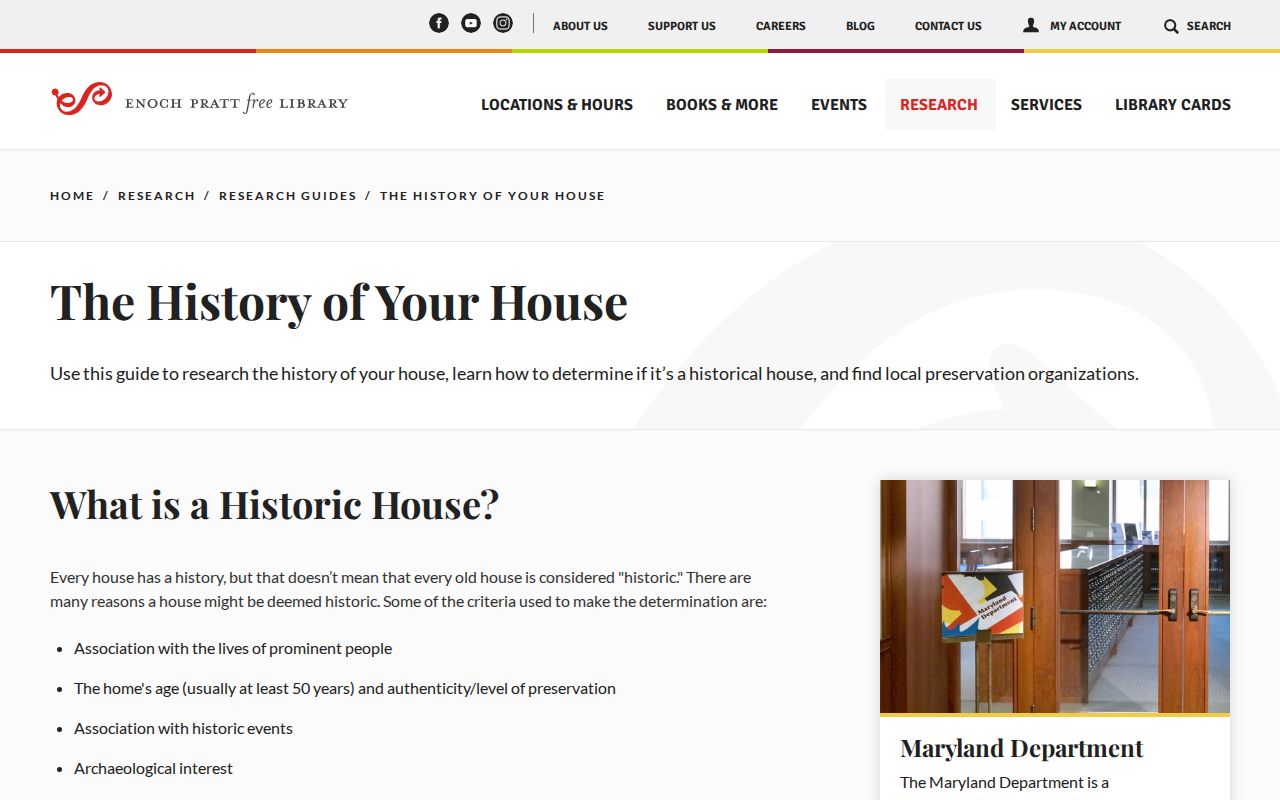
Maps explain the building. They do not name a household. The Enoch Pratt house-history guide lays out the Baltimore toolkit: SDAT, earlier assessments, deeds, plats, atlases, zoning, aerials, CHAP, and newspapers. Maryland Sanborn access runs from 1890 to 1953. A 1928 Baltimore image covers Guilford, Hampden, Roland Park, Woodberry, and Johns Hopkins. A Sanborn sheet shows footprint, stories, material, outbuildings, and lot.
The Great Baltimore Fire of 1904 adds a separate property trail for the central city. The fire destroyed about 1,500 buildings over roughly 140 acres. BRG47-19 holds fireline accounts from 1904 to 1930. BRG58-6 indexes HRS records, 1900 to 1924. BRG13-4 carries street-improvement property records stretching from 1873 to 1964. Burnt District Commission records run 1904 to 1907. A fireline inspection card can name an owner or occupant and sketch a street diagram, giving a dated clue when a standard directory stays silent.
The Pratt guide sets the Baltimore sequence: parcel card, then deed, map, plat, newspaper, and old address form.
Old addresses can shift. Spelling and abbreviation variants matter for Baltimore previous residents because an earlier address may carry a different number, suffix, or street form than the one on a modern map.
Match Baltimore Previous Residents to Dated Households
Ownership is only one layer. A deed names the holder, not every occupant. For Baltimore past residents, pair each stretch of the deed chain with nearby city-directory years and the matching federal census period. Baltimore directory titles begin in 1752 and 1796. Many publisher runs follow, with listed holdings through 1964 that vary by title, along with business and specialty directories. A street section reads address-first. The alphabetical section can confirm name spelling, occupation, or a related business. Pratt's guide also cites federal census holdings from 1790 to 1930 and Port of Baltimore passenger-list references from 1820 to 1948.
- Set a narrow date range between two Baltimore deed references or known Baltimore address events.
- Find a Baltimore directory near each end of that range and transcribe the exact street line, year, page, publisher, name spelling, and occupation.
- Search the relevant census year for a Baltimore household whose age, occupation, family details, and address context agree with the directory lead.
- Use a Baltimore newspaper, map, probate record, or another directory year to corroborate the connection before treating it as a historical household match.
The sources themselves sit on another shelf. Publisher runs, access paths, and reading conventions belong with the Baltimore city directory collections. Keep this Baltimore trail on one address, moving backward.
Close Baltimore Previous Residents With Endpoints
Addresses drop out of directories for reasons worth chasing. A death notice, cemetery record, probate file, or estate deed can explain why a Baltimore household vanishes. Baltimore City vital series begin in 1875. Current certificates carry eligibility and age restrictions. The state Division of Vital Records runs Maryland's current service, while older Baltimore indexes and certificates follow Maryland State Archives series and ordering rules. The Baltimore Register of Wills and Orphans' Court can add estate context, naming an executor, devisee, or guardianship link. Never use those fields to pin a current location on a living person.
Pratt's Periodicals Department handles death-notice and obituary checks. Requests need a near-exact death date, last residence, and burial details. The limit is five specific searches per month. Baltimore Sun coverage identified by Pratt runs from 1837 to 1993, with digital microfilm from 2008 forward and later database coverage. Date every result. Keep the repository and page. Compare each find against the block, deed, and directory timeline before trusting it.
Lawful use. Baltimore previous-resident research is for house history, family history, estate questions, and personal curiosity. Do not use historical or current records to harass, track, intimidate, or harm any living person.
Deed work deserves an image check. The MDLandRec search entry shows the Clerk and Book/Page route Baltimore researchers use once a liber/folio reference is saved.
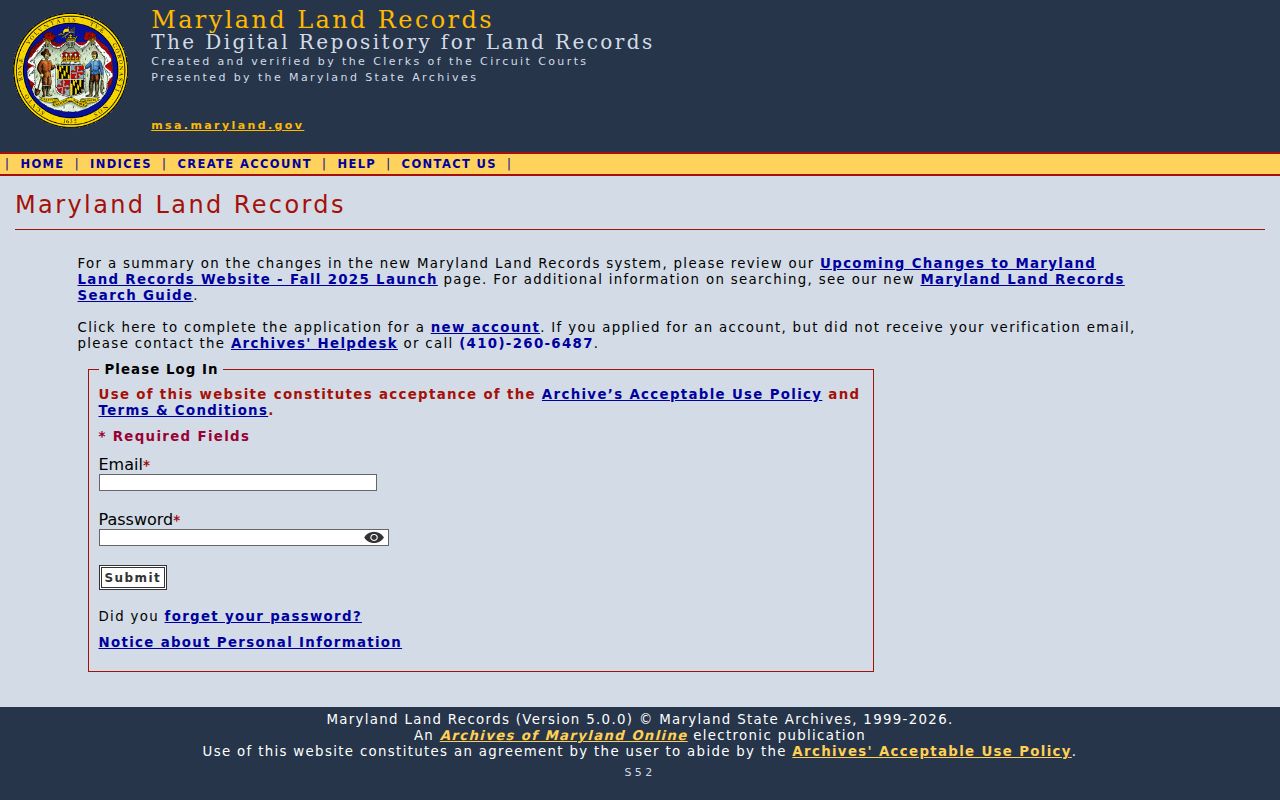
That index sits behind a login. Read the image as a recorded land instrument, paired with dated occupancy sources, not as a public roster of Baltimore previous residents.