
Finding Baltimore Resident Records
No unrestricted roll lists every Baltimore household. The useful Baltimore residents directory trail depends entirely on where you start. An address works best in sequence. Pull the Baltimore assessor card, then a map or block record, then a deed or dated directory. A name points toward a public court summary, a historical Baltimore directory, a business or license record, or an archive finding aid. Family work adds vital indexes, obituaries, and probate files. A single match is a lead, not an identification.
Keep each Baltimore record tied to its own claim. A deed records an interest in land. A permit records a project or applicant. A directory line captures only what one edition printed in its year. Those distinctions keep former owners, business contacts, and past residents from becoming unsupported claims about a living person. Match the record to the claim, every time.
- Write down the exact name or address, the year, and any useful detail such as a middle initial, street direction, or occupation.
- For a Baltimore address, check SDAT first, save the account or PAN and the deed reference, then inspect the block context.
- For a named person, narrow Maryland Case Search by court, date, and party role before accepting a same-name result.
- Use a historical city directory or archive collection to test whether the name and address line up in the same period.
- Ask the actual custodian for a specific unavailable record through the Maryland Public Information Act when an index is not enough.
Baltimore City Records, Not County Records
Baltimore City is an independent city, equal to a county under Maryland law. Its records do not sit in Towson. Baltimore County offices handle county matters only. Inside the city, the chain runs through the Baltimore City Circuit Court, the city's SDAT selection, city maps and tax tools, the local elections board, and Baltimore City Archives. Postal wording misleads near the city line. Confirm the jurisdiction before paying for copies or filing a request.
The same boundary shapes court filters. Maryland Judiciary Case Search keeps Baltimore City Circuit Court and District Court separate from other jurisdictions. The State Archives organizes material by Baltimore City series and block records. A city search can still cross statewide services. The Maryland Department of Health Division of Vital Records is one. Maryland Voter Services is another. The local location stays the key that directs everything.
Note: A Baltimore mailing ZIP can overlap the county, so rely on the property, map, or court jurisdiction instead of the postal city line.
Baltimore Address Records in Layers
Property research works best as a handoff, not one lookup. Maryland SDAT Real Property Search accepts a Baltimore City address, a street, an account or PAN, or a map reference. Owner-name and ZIP searching are not supported. Treat the results as labeled fields rather than a combined resident profile: account, location, owner line, mailing address, own-occupancy field, block and lot data, and deed reference each stand alone.
The parcel layer comes next. Use Baltimore City Planning GIS, CityView, or BCDOT records for the parcel, street centerline, boundaries, and block setting. Recorded instruments belong to MDLandRec and the Circuit Court. Maryland land records are public, but the live repository requires a free account, and its public jump tool works from Clerk, Book, and Page. The Maryland Courts land-record guidance also points researchers to courthouse terminals.
- PAN or account
- The parcel key used to carry an SDAT result into a Baltimore block, tax, or map search.
- Situs or location
- The premises label on the property card. It is distinct from a correspondence address.
- Mailing address
- Where tax correspondence goes. It can belong to an owner who does not occupy the parcel.
- Liber/folio
- The book and page reference that leads to a recorded deed image or earlier instrument reference.
Baltimore Resident Records Offices
No single Baltimore office holds the whole record trail. The Baltimore Circuit Court Land Records/Licenses Division preserves recorded instruments. Baltimore SDAT supplies the current assessment and property-card view. Voter services rest with the State Board and the Baltimore City Board of Elections. BCDOT's Property Location Section handles map and street questions. For an address-by-address method, the Baltimore street directory follows that chain in greater detail.
Baltimore City Circuit Court Land Records
Clarence M. Mitchell Jr. Courthouse
100 N Calvert Street, Room 610
Baltimore, MD 21202
410-333-3760
Maryland SDAT
State assessment records
Baltimore City code 03
Real Property Search
Maryland Voter Services
State voter self-service
Local-board routing available statewide
Voter Search
Published hours differ for the Baltimore court research library. Recording and reproduction service keeps its own schedule. Check both before a visit. Bring a Baltimore block or lot. Bring the SDAT account, street name variants, and the oldest known deed reference. Clerks provide access and copies. They will not do title work or give legal advice.
Baltimore SDAT Search Fields
SDAT moves fast once the address is known. Select Baltimore City, code 03, then pick an address, street, account or PAN, or map-reference method. Exact street spelling, directions, and suffixes all affect results. The official instructions permit two tricks. Omit the house number to expose an entire street. Use an asterisk to truncate a street name. Expect no ZIP, neighborhood, subdivision, town, or owner-name search field.
| Baltimore SDAT field | Baltimore use | Baltimore caution |
|---|---|---|
| County | Select the Baltimore jurisdiction | Choose Baltimore City, code 03. |
| Street address or street | Find the Baltimore parcel card | Try approved Baltimore spelling variants and omit the number for a broader street result. |
| Account or PAN | Use a known Baltimore parcel identifier | Preserve Baltimore ward, section, block, lot, and any letter suffix exactly. |
| Map reference | Find a Baltimore mapped parcel | Use Baltimore BCDOT context because Maryland Planning tax maps are not produced for Baltimore City. |
The Baltimore detail card can show the last recorded deed owner line, a transfer reference, values, use, own-occ code, year built, and a vacant indicator where present. It is an informational assessment index. Nothing more. It is not a title report, and it does not tell you who sleeps at the Baltimore address.
Baltimore Permit and Property Clues
Permit files add a dated record to a property. They do not pretend to be a household roster. Baltimore E-Permits public search offers two paths. One is lookup by record number. The General Search is broader. It filters by record type, project name, street number range, parcel or block-lot, unit, street name, direction, and license identifiers. Each result row can display date, record number, type or module, notes, project, and status. Attachments, payments, amendments, and inspections sit behind an account sign-in.
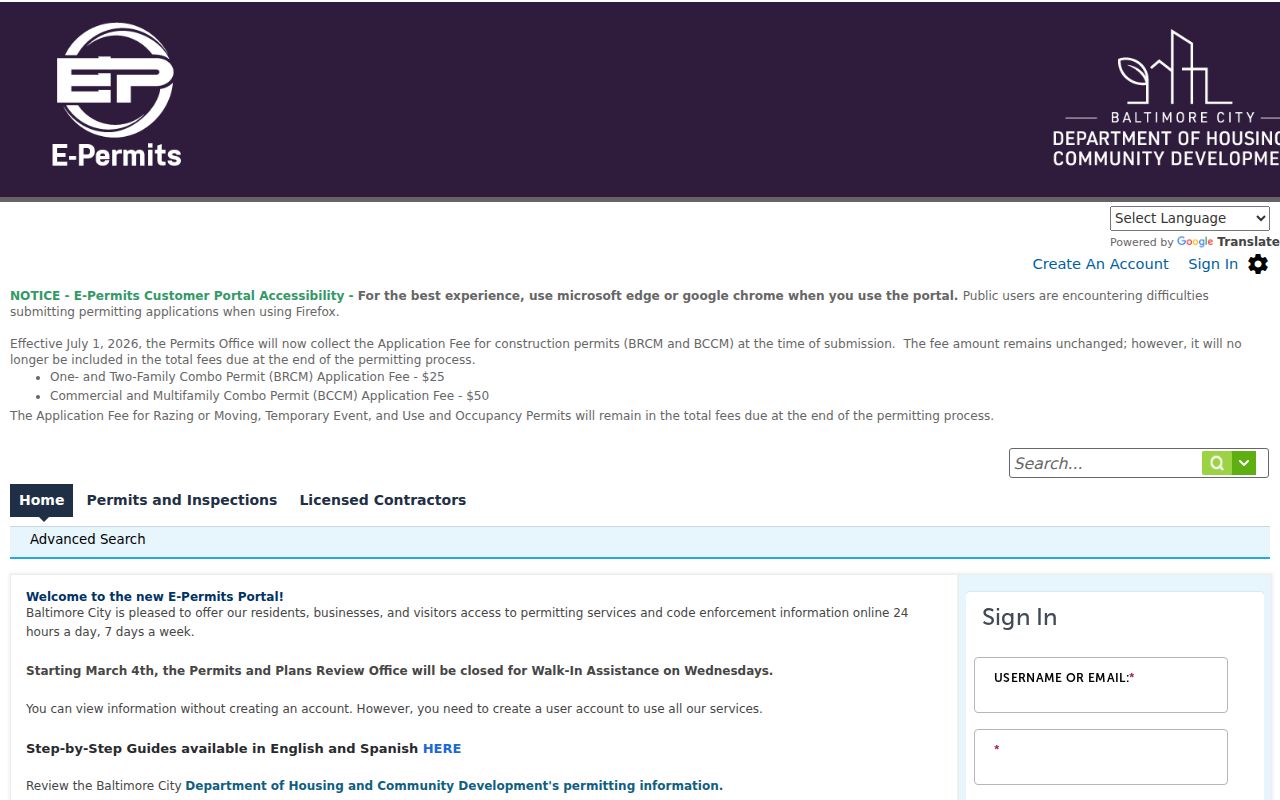
A permit file can document an application. It can also name a licensed professional, an inspection, or the status of the work. It proves neither ownership nor current occupancy. Treat it as one clue among many. The OpenBaltimore permit layer adds a second route. Its fields cover address, block-lot, issue and expiration dates, existing and proposed use, project, cost, neighborhood, and geometry. Coverage and pagination limits still apply. A blank result is not the final word on a property.
Current Baltimore Resident Directory Sources
Each current directory-style source answers one narrow question. Keep them in their own lanes. A property card names the last recorded owner, not every occupant. Maryland Voter Search exists for a registrant's own verification. Case Search is a public index of case summaries. The Community Association Directory lists organizations and contacts, not member households. Respecting those limits builds a far more accurate Baltimore residents directory workflow than treating any single source as a master file.
| Baltimore record route | What it can show | Baltimore custodian | Baltimore access limit |
|---|---|---|---|
| Baltimore SDAT property card | Baltimore owner line, parcel, mailing and situs fields, deed reference | Maryland SDAT | Public Baltimore index, not occupancy. |
| Baltimore Voter Search | A registrant’s Baltimore status, polling place, districts, ballot services | Maryland elections | Baltimore self-lookup with name, DOB, ZIP, and address validation. |
| Baltimore Case Search | Baltimore public party and case-summary fields | Maryland Judiciary | Baltimore confidential and shielded categories are excluded. |
| Baltimore E-Permits | Baltimore project and address-related record information | Baltimore City | Not a Baltimore resident roll; some functions require an account. |
| Baltimore Community directory | Baltimore organization, boundary, and public contact fields | Baltimore City | No Baltimore association membership list. |
Baltimore Voter Search Boundaries
Maryland Voter Search asks for first name, last name, date of birth, ZIP code, and usually address validation. It returns registration status, a polling place, and district and precinct assignments. It also lists the local board and ballot-related services. It is not a name-only resident directory. It is not a street roster either. A no-match can mean a spelling change, a former name, or an old ZIP code. It can also mean lag after an update, just as easily as a wrong identity.
A statewide, county, district, or municipality voter file follows a separate request process with stated use restrictions. Maryland Election Law §3-101 and the State Board's request materials govern voter-list access. The request oath bars commercial solicitation, sale, and unrelated use. Protected-address information stays confidential. Use self-service only for your own record or with consent. Take broader questions to the elections custodian.
Baltimore Court Search by Detail
Maryland Judiciary Case Search is a public summary tool. It is not a complete court file and not a city resident list. Party search starts from an exact last name by default. You can narrow it by first or middle name. You can also narrow by party type, case type, court system, county, and filing-date range. Baltimore City Circuit and District Court are distinct filters. The result schema covers case number, name, date of birth where displayed, party type, court, type, status, filing date, and caption.
The portal caps broad results at 500. A case number or a tighter court and date range beats a large surname sweep. Coverage is date-specific too. Baltimore City Circuit civil records start November 23, 1998. Criminal records start 1993. District Court civil reaches back to 1989 and criminal to late 1991, all subject to exceptions. Sealed, confidential, juvenile, family, and expunged categories are simply outside the public picture.
Note: A court summary can confirm a dated case connection. It cannot establish a person's present address, guilt, or identity without independent records.
Baltimore Block Numbers Tell Stories
Baltimore numbered its blocks in a way that still opens doors for researchers. Old-city blocks run from 1 through 2099. The 1888 annexation brought in blocks 2100 through 4199. The 1918 annexation took the range up to 8491. When a street was renamed, extended, or renumbered, a block number can keep a parcel tied to its earlier identity. BCDOT Property Location records and State Archives block materials let you carry a current address back into older maps, plats, and land-record indexes.
The 1886 citywide renumbering is the other checkpoint. The 1887 Baltimore Street Directory bridges old and new house numbers. Search that bridge before dismissing an earlier directory, newspaper, or deed reference as unrelated. Keep the exact street direction and suffix too. A property that joined Baltimore City through the 1918 annexation may not match its neighborhood's older street pattern, and the annexation plat book can settle that kind of mismatch.
Historic Baltimore Resident Directories
The Baltimore City Archives directory index is the first shelf to visit. It holds dated household evidence in one place. Microfiche covers 1752 through 1860, and microfilm runs from 1861 through 1930. Later holdings shift between print and digital formats, depending on publisher and location. City, business, social, street, and telephone volumes cover one stretch of ground. Suburban, car and bus, and specialty volumes cover another. Copy the publisher, year, page, spelling, occupation, and address exactly as printed.
Polk and similar publishers often bundled alphabetical, classified, and street sections in one volume. Check a street line against the alphabetical section and neighboring editions. Then pair it with census, newspaper, cemetery, deed, or probate material. The full repository and publisher route is laid out in the Baltimore city directory collections. A dated entry is valuable historical evidence. Still, it proves nothing about ownership, kinship, or present residence on its own.
Baltimore Archives and Community Contacts
The Maryland Center for History and Culture finding aids open a deep doorway into Baltimore's written past. Search by keyword, record type, name, or date range. Deeds, church records, family papers, manuscripts, and photographs all sit in the catalog, which lists 1,444 collections and 34,641 digital materials. Availability varies by collection, though. One finding aid may lead straight to an online image, while another points to microfilm, an on-site visit, or staff assistance.
Baltimore's official Community Association Directory answers a different kind of question. It connects residents with their neighborhood organizations. The search covers association name, address, contact, council district, category, boundary, and last-update fields. Boundaries are easy to trace. It publishes no member or neighbor lists.
Note: the Baltimore City Archives is closed for a 2026 renovation, so check the current notice before a visit.
The Enoch Pratt Free Library adds another path. Its genealogy guide maps the Central departments holding city directories, federal census material, naturalization indexes and petitions, passenger lists, newspapers, and African American collections. Periodicals staff will check Baltimore death notices and obituaries when a requester supplies a close death date, last residence, and burial details. The cap is five specific searches per month. A precise year and address beats a broad surname.
Baltimore Records Need Safe Handling
Maryland's Public Information Act, General Provisions Article Title 4, opens a path to many government records, yet it leaves statutory privacy rules fully intact. A good request names the custodian, the records sought, the date range, the format, and contact information. Custodians can ask for clarification, an estimate, or payment. They may also redact or withhold protected material. The Attorney General's PIA Manual explains the framework.
Maryland's Safe at Home Address Confidentiality Program gives qualifying participants a substitute address with mail-forwarding protections. That shield matters here. Vital, court, voter, vehicle, and safety-sensitive data can carry further restrictions. An incomplete or substituted address deserves respect, not a hunt for what lies beneath it.
Careful historic work calls for a small evidence ledger. Record the source, the series or portal, the search field, the search date, the exact result, the time period, and the privacy decision. That habit pays off quickly. A Baltimore name might come from a property card, a directory line, a permit, or an organization contact. The ledger shows which. It also eases later corrections when a custodian updates a record or a new source contradicts an early lead.
| Official record route | Commercial search category | Why the difference matters |
|---|---|---|
| Shows the custodian, date, source limits, and correction route. | May combine data with unclear update dates and methods. | Use the official custodian to verify a specific field. |
| Often has stated access rules and redactions. | May not explain why a result is absent or stale. | Do not turn a broad match into a current-person claim. |